David Casini/Alter ego
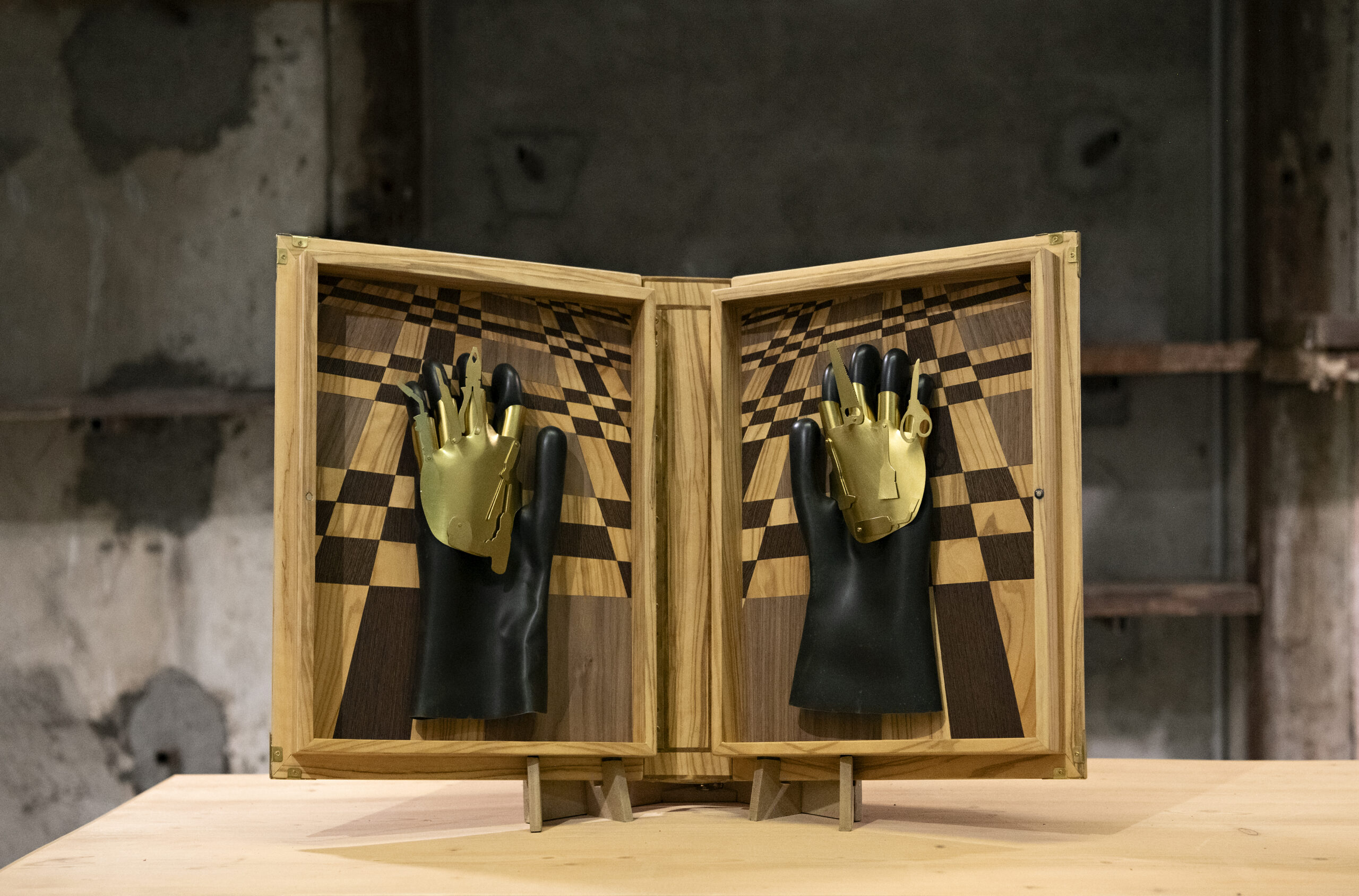
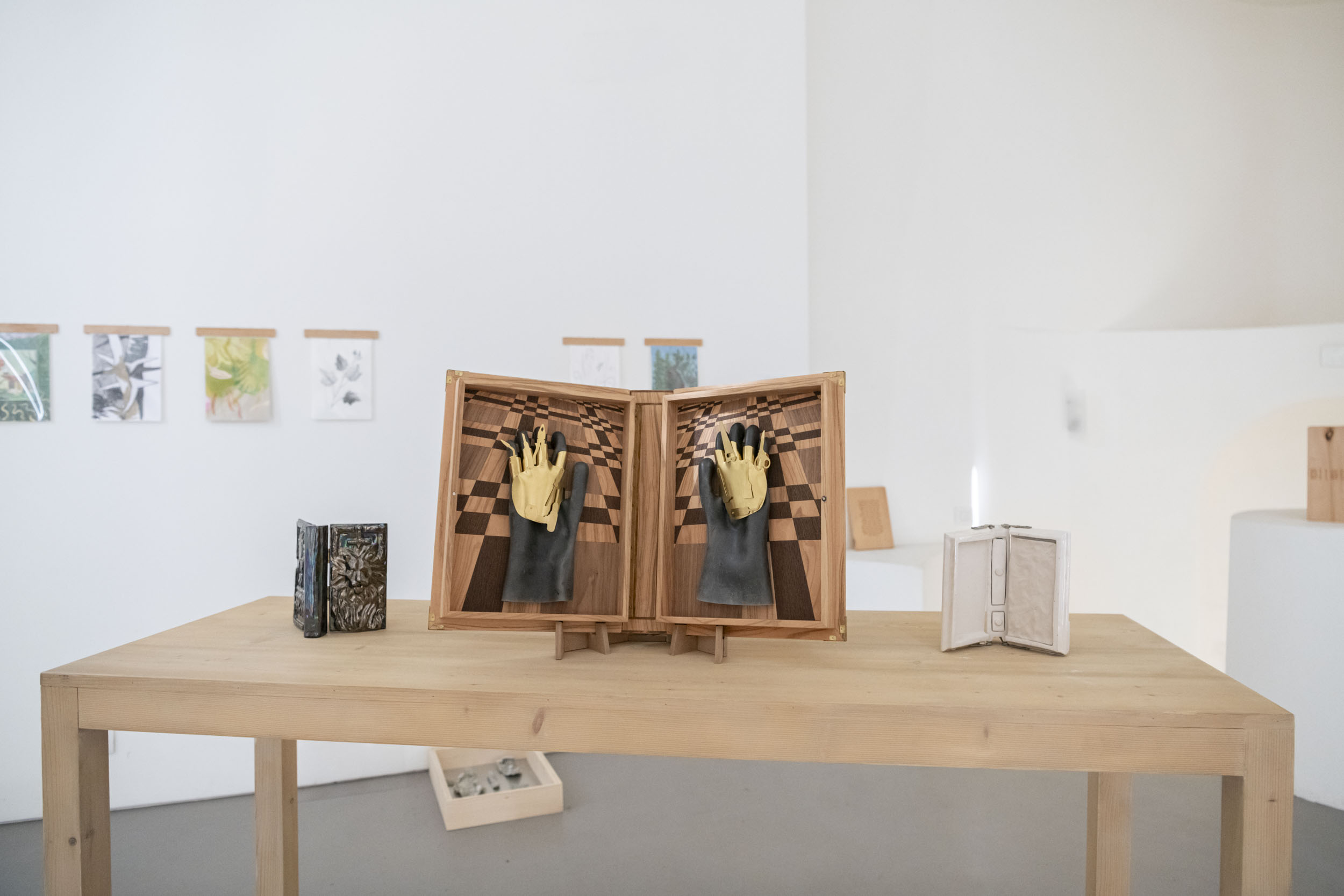
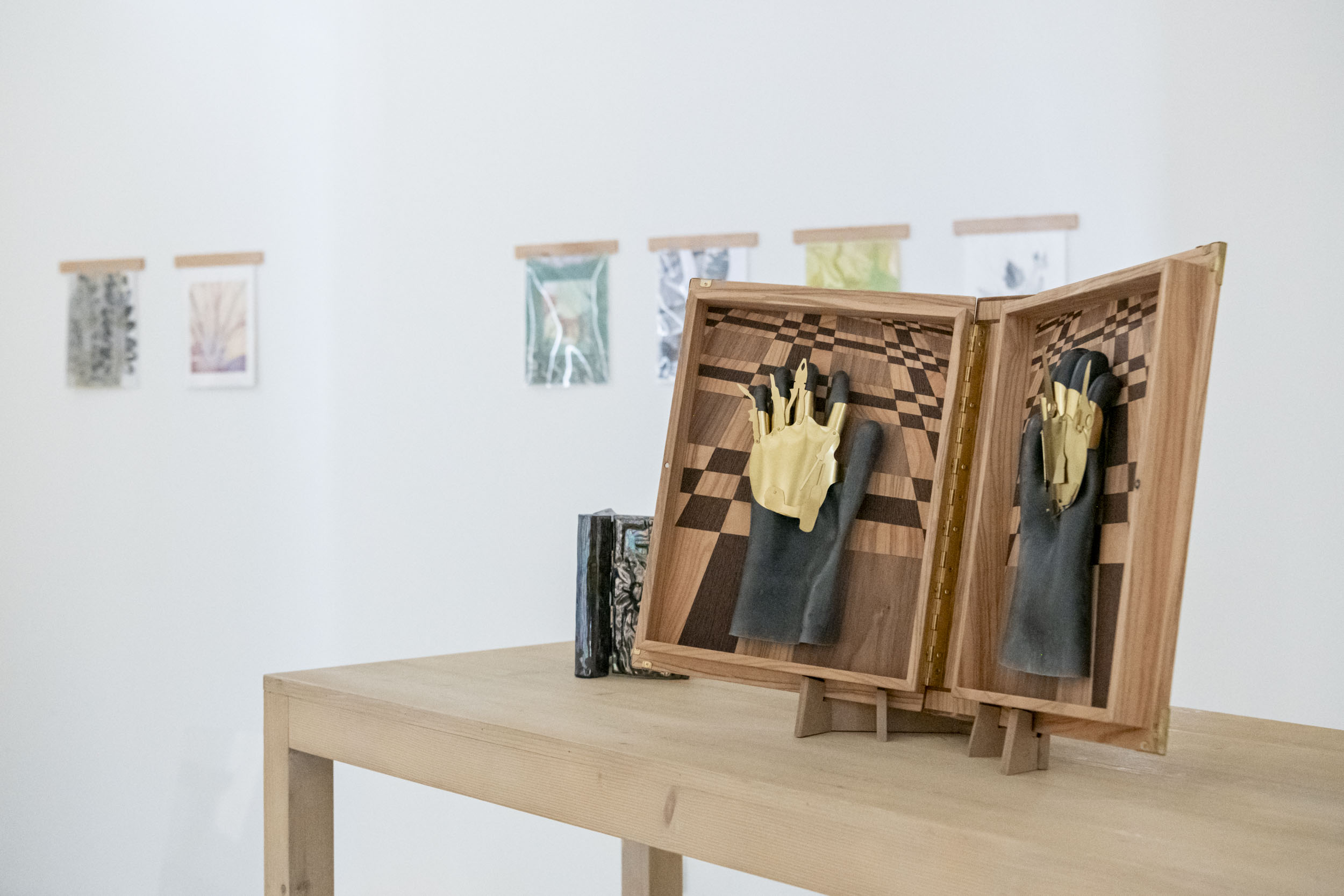
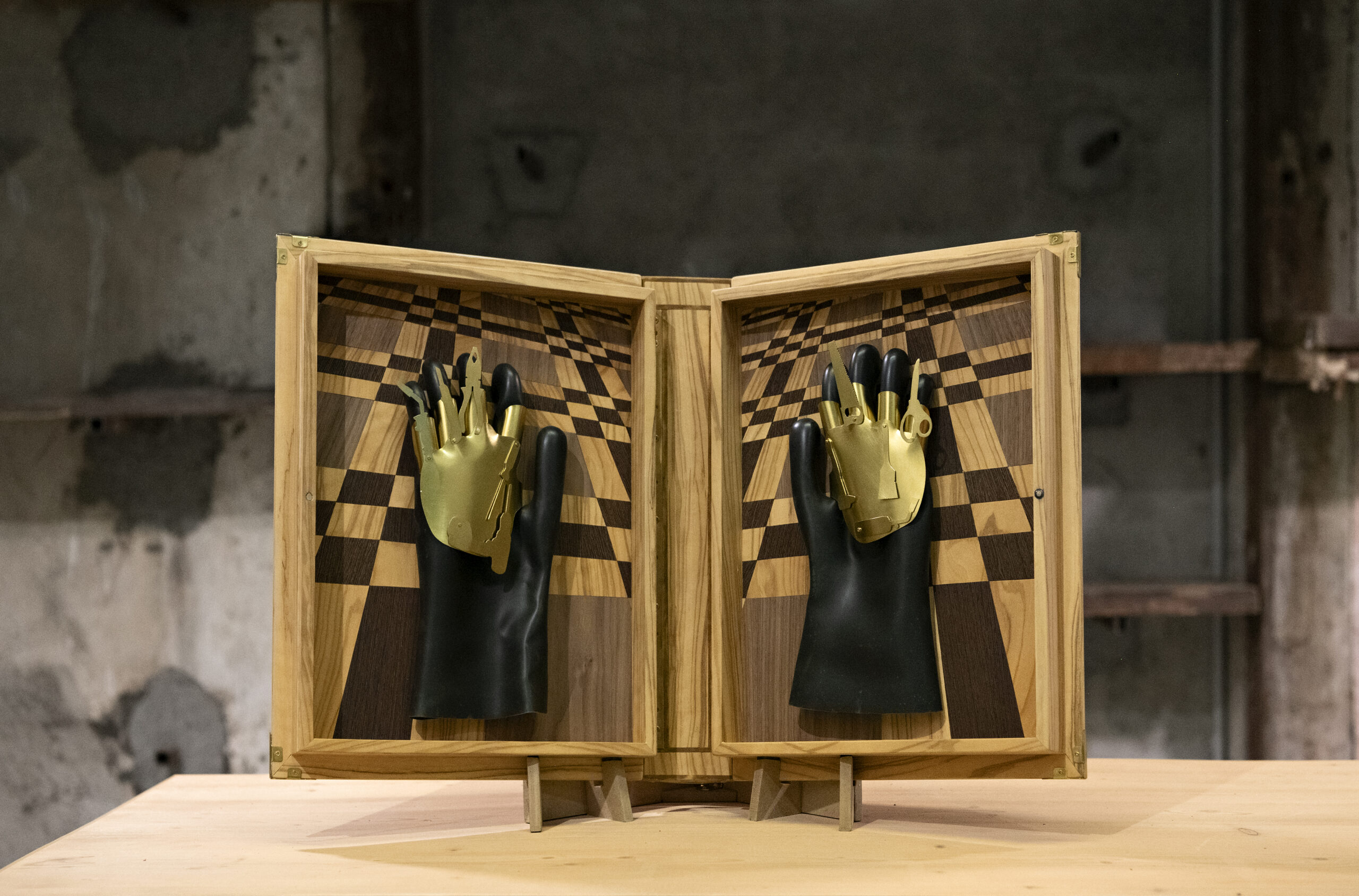 David Casini, Alter ego, intarsio in legno, ottone, guanti in gomma, 40x65x16 cm (libro aperto), 2025.
—
L’opera contiene al suo interno dei preziosi intarsi e un laboratorio in miniatura, il laboratorio dell’artista.
Come ogni esemplare della Xiloteca, anche questo libro – con le sue essenze lignee e i suoi dettagli, racconta
una storia e una processualità.
Attraverso la scelta delle specie legnose utilizzate per la sua realizzazione, l’opera narra la storia dell’artista
artigiano e del suo laboratorio. Casini ha rappresentato il proprio laboratorio: due guanti in lattice indossano
due armature in ottone che richiamano la forma di un coltellino svizzero. Ogni elemento riproduce un utensile
realmente utilizzato dall’artista nel suo spazio di lavoro: trapano, fiamma ossidrica, sega, forbici, taglierino, cacciavite. L’intarsio è realizzato in legno d’olivo: l’artista, di origini toscane, ha scelto questa specie, diffusa in Val d’Arno, come rivestimento dell’intero libro. Altre specie sono state impiegate per ottenere effetti di chiaroscuro. Gli intarsi all’interno del libro riproducono il pavimento dello studio dell’artista, ispirandosi all’antica decorazione del laboratorio. Il libro vuole essere un manuale del lavoro dell’artista, un racconto del suo ambiente di creazione. Non si tratta di una retrospettiva, ma di un libro di legno che custodisce la storia dell’artista e dei suoi strumenti.
La proposta di David Casini si inserisce all’interno della collezione di libri di legno conservata presso il Centro
Studi per l’Ambiente Alpino di San Vito di Cadore. Questa straordinaria Xiloteca è composta da libri-teca, al cui interno è conservato quanto può servire alla classificazione della singola specie arborea e a comprenderne le sue possibili utilità. Seguendo la stessa logica, l’esemplare realizzato da Casini si configura come un’opera scultorea a forma di libro, che contiene – miniaturizzati – gli elementi del laboratorio dell’artista. Così come il libro di legno è una descrizione materica dei singoli alberi, questo nuovo esemplare vuole essere una rappresentazione del luogo in cui l’artista lavora, riprendendo una lunga tradizione di raffigurazioni pittoriche e fotografiche degli atelier, che va da Henri Matisse a Picasso, da Andy Warhol a Jackson Pollock. In questo caso, la meta-narrazione si sviluppa attraverso i materiali utilizzati abitualmente dall’artista e divenuti suo segno distintivo, come l’ottone, l’intarsio ligneo e la stampa laser UV. L’oggetto-libro, dalle dimensioni simili agli storici libri in legno, è lo “scrigno” al cui interno si rivela una wunderkammer, un micro universo fatto di piccoli oggetti, utensili, macchinari e immagini fotografiche grazie a cui il pubblico può esplorare un luogo solitamente inaccessibile e privato dell’artista.
—
L’opera è parte del progetto XILOGENESI.
Xilogenesi
La collezione di libri in legno di Eugenio Trevisan
Dal diciannovesimo secolo ad oggi
La storia, il restauro, l’arte contemporanea
Orto botanico di Padova, Museo botanico
Via Orto botanico 15, Padova
Dal 27 settembre 2025 al 6 gennaio 2026
Inaugurazione venerdì 26 settembre alle ore 18.00
Qui aperture e orari del Museo botanico.
—
David Casini, Alter Ego, wood inlay, brass, rubber gloves, 40x65x16 cm (open book), 2025
The work contains fine inlays and a miniature studio – the artist’s own.
Like every piece in the Xylotheque, this book, with its wood essences and details, also tells a story and a creative process.
Through the choice of wood species used in its making, the work recounts the story of the artist-craftsman and his studio. Casini has represented his own studio: two latex gloves support brass armour pieces shaped like a Swiss Army knife. Each element reproduces a tool actually used by the artist in his workspace: drill, blowtorch, saw, scissors, utility knife, screwdriver. The inlay work is made of olive wood: the artist, of Tuscan origin, chose this species, widespread in the Arno Valley, as the covering for the entire book. Other species were used to create light-and-shadow effects. The inlays inside the book reproduce the floor of the artist’s studio, inspired by the ancient decoration of his studio. The book is intended as a manual of the artist’s work, a narrative of his creative environment. It is not a retrospective, but a wooden book that preserves the history of the artist and his tools.
David Casini’s proposal is part of the collection of wooden books preserved at the Centre for Alpine Environment Studies in San Vito di Cadore. This extraordinary Xylotheque consists of book-objects containing everything needed to classify individual tree species and understand their possible uses. Following the same logic, Casini’s creation is a sculptural work in the shape of a book, containing miniaturised elements from the artist’s studio. Just as the wooden book is a material description of individual trees, this new piece aims to represent the place where the artist works, drawing on a long tradition of pictorial and photographic depictions of studios, from Henri Matisse to Picasso, from Andy Warhol to Jackson Pollock. In this case, the meta-narrative unfolds through the materials habitually used by the artist and which have become his hallmark, such as brass, wood inlay and UV laser printing. The book-object, similar in size to historical wooden books, is a “treasure chest” that reveals a wunderkammer – a micro-universe made up of small objects, tools, machinery and photographic images, allowing the public to explore a place that is usually inaccessible and private to the artist.
—
The work is part of the XILOGENESI project.
Xilogenesi
Eugenio Trevisan’s collection of wooden books
From the nineteenth century to the present day
History, restoration, contemporary art
Padua Botanical Garden, Botanical Museum
Via Orto Botanico 15, Padua
From 27 September 2025 to 6 January 2026
Opening on Friday 26 September at 6:00 p.m.
Here the opening times of the Botanical Museum.