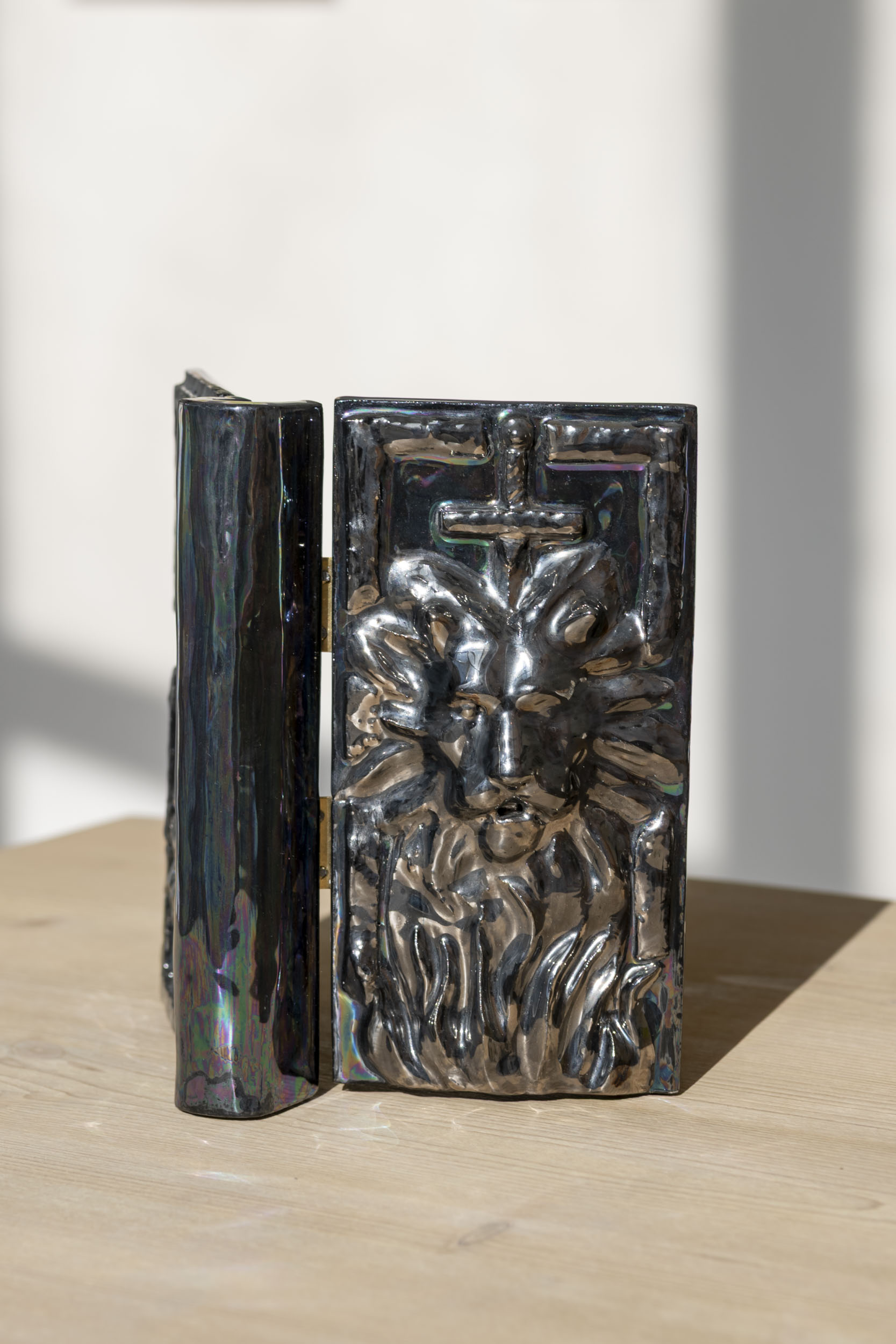
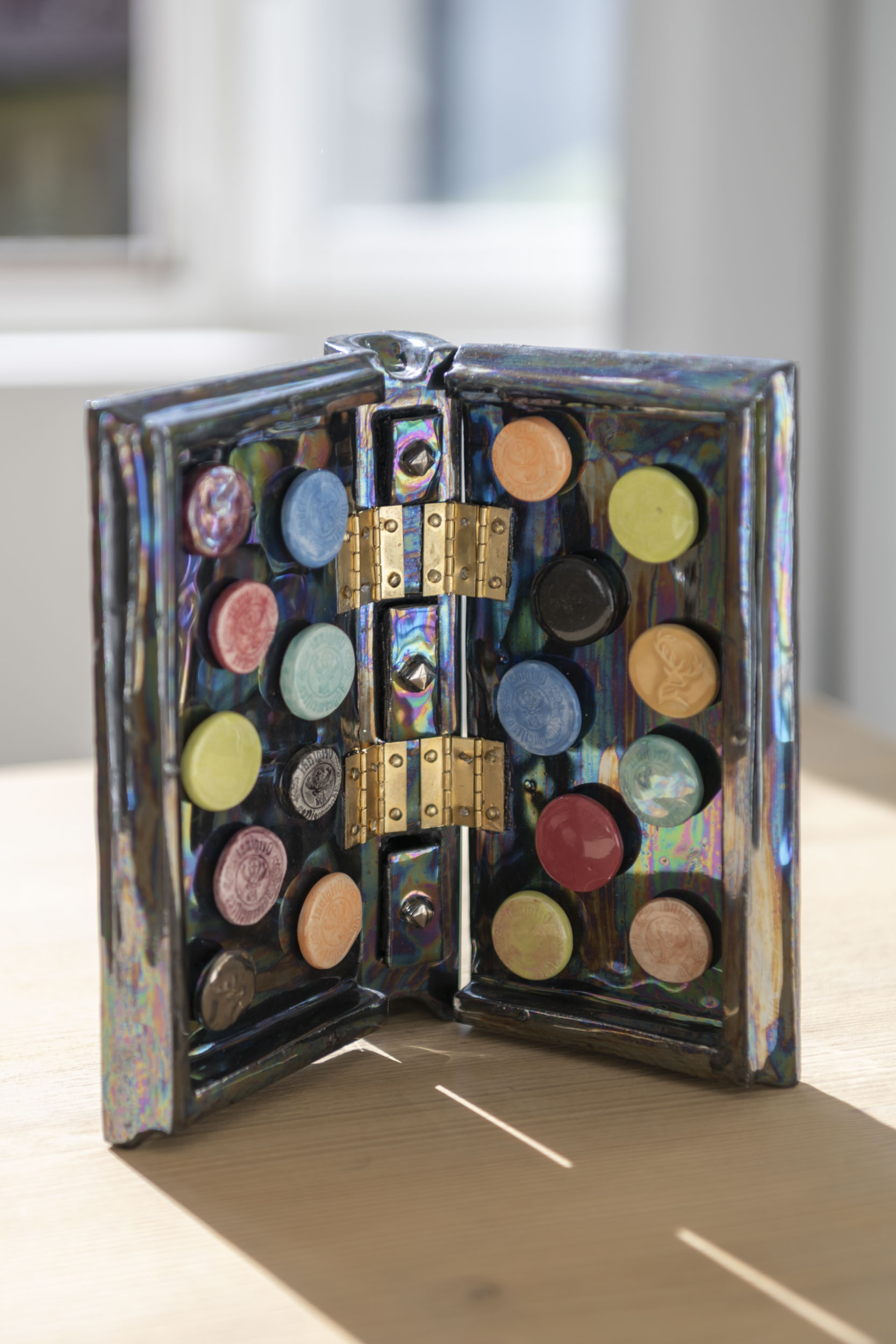
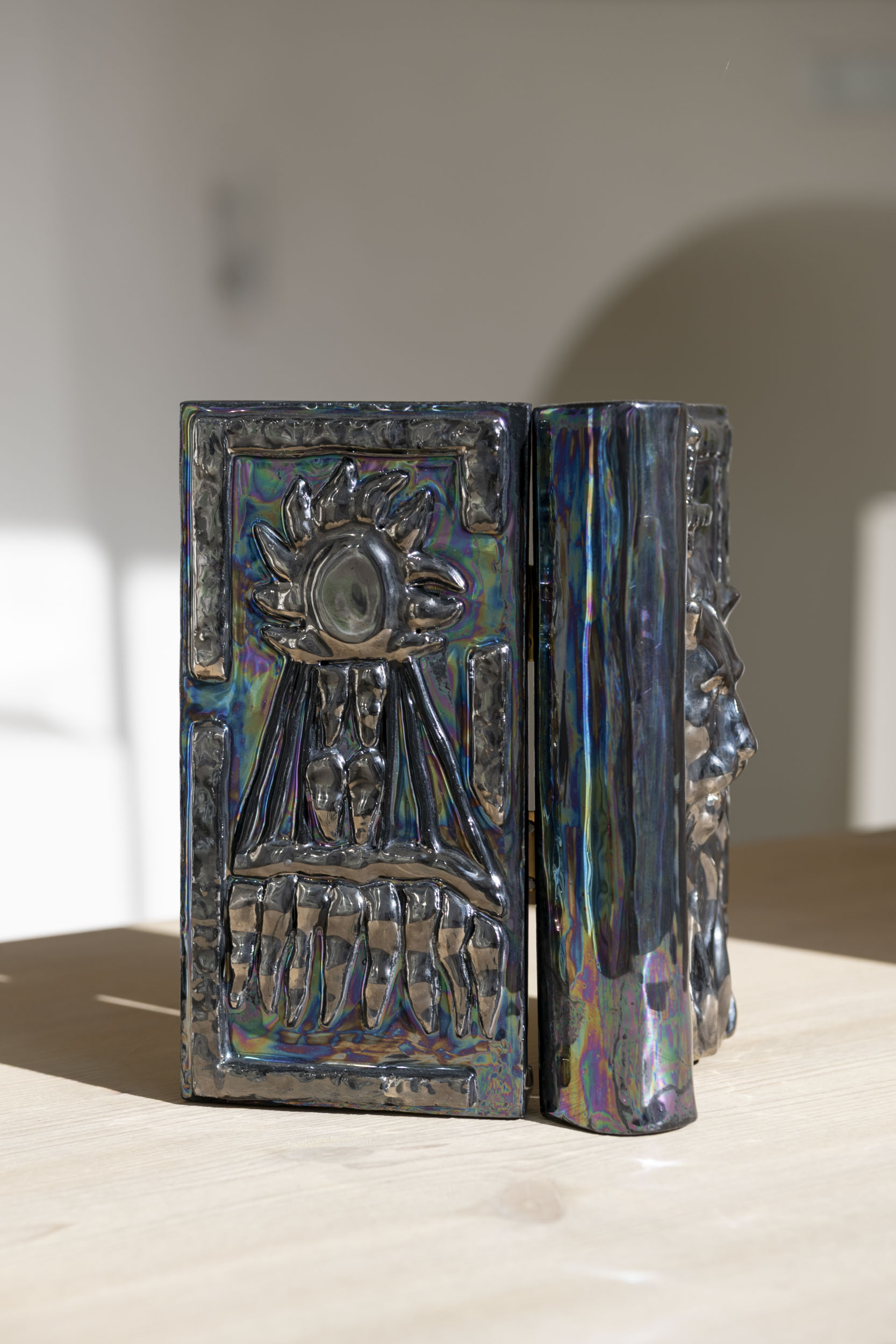
Kristian Sturi/Ierofania ceramica (Xilogenesi parte III)
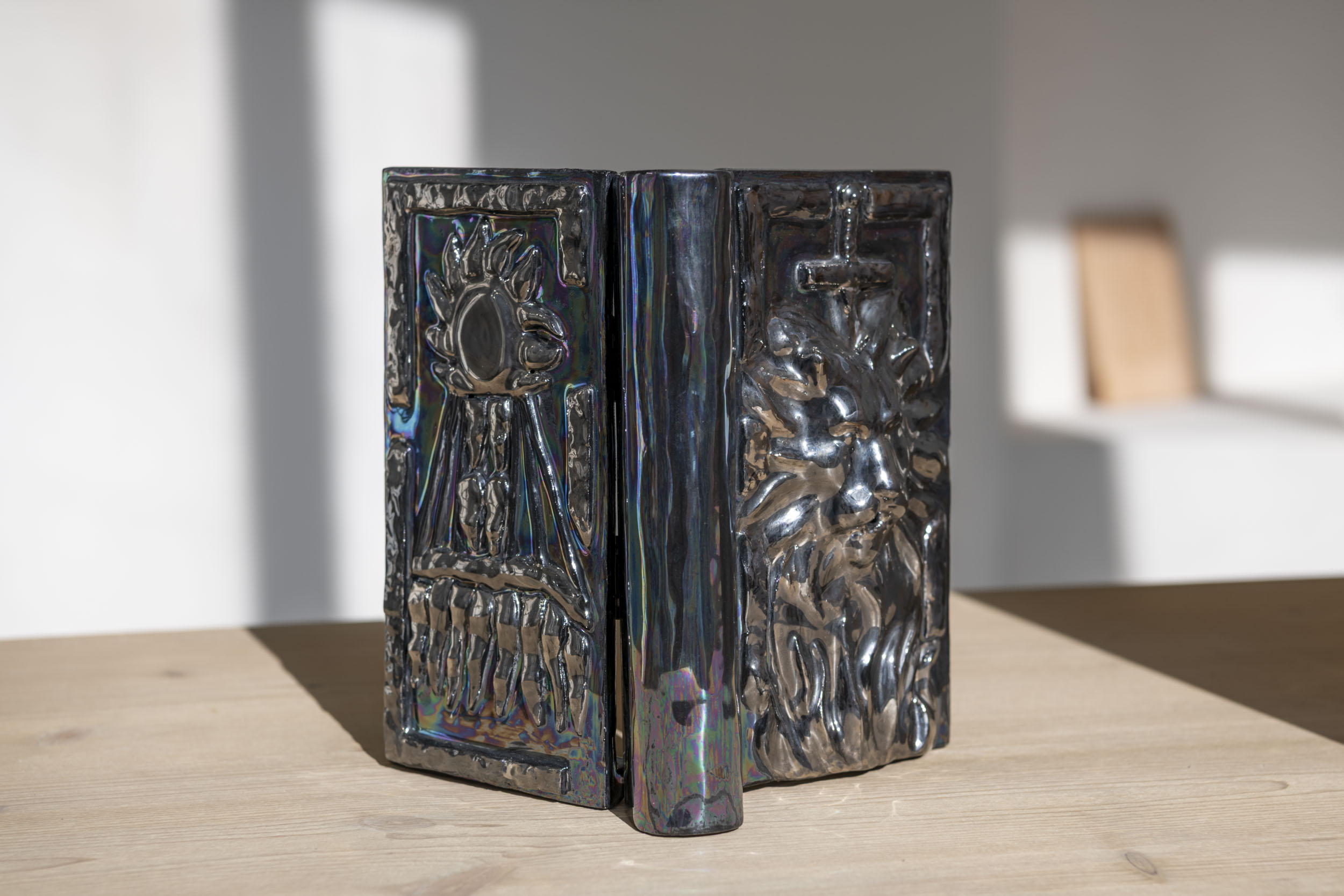 Kristian Sturi, Ierofania ceramica (Xilognesi parte III), ceramica smaltata, cristalline, lustri metallici, cerniere in ottone.
—
Kristian Sturi ha lavorato alla realizzazione di più volumi destinati a integrare la collezione originale. I libri hanno le stesse dimensioni degli esemplari della Xiloteca, 21x13x5 cm, ma sono in ceramica. Il lavoro di Sturi è un omaggio a tre concetti fondamentali, cari all’artista e al suo percorso di formazione: il materiale ceramico e il suo potenziale espressivo e di lavorazione; il libro, inteso come manufatto medievale, considerato per sua natura un oggetto prezioso; il concetto alchemico, evocato attraverso diversi simboli iconografici — come il sole, il leone, la fiamma e l’atanor (primo volume) – che rimandano esplicitamente a quel mondo. “È un omaggio che faccio a tre dei grandi temi che accompagnano la mia vita e la mia ricerca da diverso tempo […] Anche stilisticamente alcuni soggetti riprendono modelli tipici medievali con la possibilità di attualizzarli o personalizzarli, quasi una sorta di breviario o libro d’ore da consultare in determinanti momenti della giornata. […] Il terzo tema è quella fascinazione per il suggerito, il non detto, che l’ alchimia richiama nei propri simboli e che qui vengono ripresi e riletti in chiave personale, dove al fuoco terrestre fa eco il fuoco solare leonino mentre nel retrocoperta un oggetto ignoto, come collegamento ipermedievale, ci riporta a quel frammento di cometa tratto dal capolavoro dell’arazzo di Beyeux; il manufatto libro divide le due luci e i due fuochi, terrestre e siderale, ritmico e sporadico, necessario e apocalittico. O come l’albero dello Jagermeister che scaturisce da due alberi in cui le chiome si intrecciano mentre alcune bottiglie sono pronte per essere raccolte, simboli legati alla dualità, alla terra, al distillato, al liquido soma capace di intercedere con gli spiriti del mondo “altro”. E la scelta di raccontare il manufatto libro è dettata anche dal materiale prescelto, che vive costantemente nell’appanaggio della sua eterna consistenza e fragilità, racchiude in sé i 4 elementi base del mondo occidentale: la terra si mescola all’acqua, si asciuga con l’aria e si irrigidisce con il fuoco“.
—
L’opera è parte del progetto XILOGENESI.
Xilogenesi
La collezione di libri in legno di Eugenio Trevisan
Dal diciannovesimo secolo ad oggi
La storia, il restauro, l’arte contemporanea
Orto botanico di Padova, Museo botanico
Via Orto botanico 15, Padova
Dal 27 settembre 2025 al 6 gennaio 2026
Inaugurazione venerdì 26 settembre alle ore 18.00
Qui aperture e orari del Museo botanico.
—
Kristian Sturi, Ierofania Ceramica (Xilogenesi parte III), glazed ceramic, cristalline, metallic finishes, brass hinges.
—
Kristian Sturi has worked on the creation of several volumes intended to complement the original collection. The books are the same size as the Xiloteca specimens (21 × 13 × 5 cm), but are made of ceramic. Sturi’s work is a tribute to three fundamental concepts that are dear to the artist and his artistic training: the ceramic material and its expressive and technical potential; the book, understood as a medieval artefact, considered by its very nature to be a precious object; and the alchemical concept, evoked through various iconographic symbols — such as the sun, the lion, the flame, and the athanor (first volume) — which explicitly refer to that world.
It is a tribute I pay to three of the great themes that have accompanied my life and my research for some time […] Stylistically, some subjects also draw on typical medieval models, with the possibility of updating or personalising them, almost like a breviary or book of hours to be consulted at certain times of the day. […] The third theme is the fascination with the suggested, the unspoken, evoked by alchemy in its symbols and here reinterpreted in a personal key, where earthly fire echoes the solar fire of Leo, while on the back cover an unknown object, like a hyper-medieval link, refers to a fragment of a comet taken from the masterpiece of the Bayeux Tapestry. The book divides the two lights and the two fires — earthly and sidereal, rhythmic and sporadic, necessary and apocalyptic. Or like the Jägermeister tree, which springs from two trees whose crowns intertwine, while some bottles are ready to be harvested, symbols linked to duality, to the earth, to distillate, and to the soma liquid capable of interceding with the spirits of the ‘other’ world.
The choice to present the book as an artefact is also determined by the material itself, which embodies both eternal consistency and fragility, and incorporates the four basic elements of the Western world: earth mixes with water, dries with air, and hardens with fire.
—
The work is part of the XILOGENESI project.
Xilogenesi
Eugenio Trevisan’s collection of wooden books
From the nineteenth century to the present day
History, restoration, contemporary art
Padua Botanical Garden, Botanical Museum
Via Orto Botanico 15, Padua
From 27 September 2025 to 6 January 2026
Opening on Friday 26 September at 6:00 p.m.
Here the opening times of the Botanical Museum.